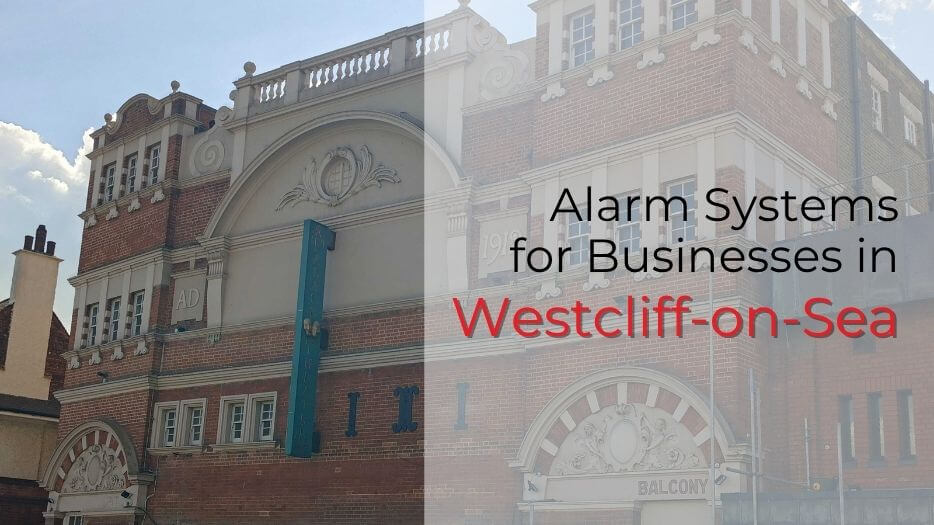
Alarm Systems for Businesses in Westcliff-on-Sea
Walk along Hamlet Court Road on a weekday morning and the pattern is obvious. Shutters go up. The opticians and hairdressers unlock, and the Post Office queue builds before nine. By early evening, most of that activity has gone. That gap – a busy daytime retail parade left quiet overnight – is exactly the window an opportunist burglar looks for.
We install and maintain commercial intruder alarms across Southend-on-Sea and the wider Essex coast. Westcliff-on-Sea’s commercial mix is distinctive: independent shops and cafes along Hamlet Court Road, the London Road corridor toward Southend town centre, and office premises near Westcliff train station. Staff and stock are exposed during trading hours – till, stockroom and lone-working risk – with little passing footfall left once the parade shutters for the night.
A commercial intruder alarm system – sometimes called a commercial burglar alarm – is a professionally designed, installed and monitored security system, specified against a recognised UK standard rather than assembled from generic parts. For a Westcliff-on-Sea retail unit, salon or office, that means a system built around staffed daytime trading and an empty parade overnight.
Who this page is for
If you run a retail unit, salon, office or hospitality business in Westcliff-on-Sea, this is written for you. You already understand what a break-in costs in stock, downtime and staff confidence. What you need is a straight answer on what a properly specified commercial alarm actually involves, and whether your current setup is good enough.
The risk profile here isn’t the unattended industrial estate you’ll read about on most alarm company websites – it’s staffed retail by day and an empty parade at night. We design around that distinction rather than a generic template.
The real risk facing Westcliff-on-Sea businesses
The Home Office 2023 Commercial Victimisation Survey, published September 2024, estimated that 26% of business premises in England and Wales were the victim of at least one crime in the previous 12 months – around 409,000 premises. Burglary, including attempts, affected 8% of all business premises over the same period.
The same survey found that wholesale and retail premises recorded the highest crime prevalence of any sector measured, with 41% experiencing at least one crime in the previous year – a figure that matters directly to Hamlet Court Road’s independent retail parade.
The national trend is more mixed than the headlines suggest. ONS figures for the year ending March 2026 (published 23 July 2026) show burglary falling 9% to 223,456 offences. That’s a combined residential and non-residential figure though, since ONS doesn’t publish a business-only breakdown, so it can’t be read as proof that commercial burglary specifically is falling.
The same release recorded a 91% rise in robbery of business property, to 29,669 offences. That rise largely reflects an April 2025 change to Home Office Counting Rules, under which forces now record any violence or threat during a business theft as robbery – it isn’t necessarily evidence of a real jump in offending.
What should concern a Westcliff business owner more is resolution, not just incidence. Home Office data on Crime Outcomes in England and Wales 2024-25 (published August 2025) shows the non-residential burglary charge or summons rate at just 8.9%, up from 7.9% the year before, with 69.6% of offences closed with no suspect identified. That’s one of the strongest arguments for a monitored system – it gives you and the police concrete evidence to act on, rather than leaving the outcome to chance.
A snapshot from data.police.uk (Home Office open data, May 2026) recorded 509 crimes within a one-mile radius of Westcliff-on-Sea town centre. Around 16 of those, roughly 3%, were burglary. That’s a radius search centred on the Hamlet Court Road area, not an official ward boundary figure. The category also doesn’t separate residential from commercial incidents. Treat it as an indicative local snapshot, not a precise commercial crime rate.
Nearby in Southend-on-Sea borough, Greg Weller, owner of The Inn at Belfairs in Leigh-on-Sea, had his premises broken into overnight in May 2024. The cash drawer was targeted, and the burglar lingered, eating and drinking stolen stock before fleeing. As Greg put it: “These sorts of incidents impact the business greatly… the effect it has on the days after running the site.” That’s the practical cost a decent alarm system is designed to prevent.
What a properly specified commercial alarm system looks like
A commercial intruder alarm isn’t just a bigger version of a house alarm. It’s specified against a recognised framework that matters when you’re claiming on insurance, or proving due diligence to a landlord.
PD 6662:2017 is the UK scheme document covering intruder alarm installation standards, mandatory for installers since 1 June 2019. Underneath it sits BS EN 50131-1:2006+A3:2020, the core standard defining security grades from 1 to 4. Commercial premises are typically specified as Grade 2 or Grade 3, depending on the value at risk and your insurer’s requirements.
Texecom control panels (Premier Elite series) are Grade 2 and Grade 3 capable, and that’s the platform we specify for Westcliff-on-Sea commercial installations. App connectivity via Texecom Connect / Smartcomm is a feature of the installed system, not an add-on.
These are voluntary standards, not legal requirements. Nobody is obliged by statute to install a Grade 2 or Grade 3 system. The real driver is usually your insurance policy conditions, and sometimes police operational policy around confirmed alarms.
Whether wired or wireless suits your premises better depends on the building – a period shopfront on Hamlet Court Road with limited cabling routes might suit wireless, while an office unit near the station with a full fit-out might take wired sensors more easily. That’s part of why every job starts with a free site survey – call us on 01702 467850 to arrange one, with no obligation.
Confirmed alarms, monitoring and police response
Not every alarm gets the same police response. BS 8243:2021 governs the conditions for a “confirmed alarm” – one where the system itself provides evidence that an intrusion is genuinely happening, rather than a false trigger. Under NPCC (National Police Chiefs’ Council) policy, only confirmed-alarm systems holding a valid URN (Unique Reference Number) normally receive a police response – a discretionary operational policy, not a guaranteed legal entitlement.
To hold a URN, your system typically needs to be professionally monitored around the clock. Once installed, your alarm can be monitored by our NSI Gold-certified Alarm Receiving Centre (ARC), run by our monitoring partner Southern Monitoring, 24 hours a day. We’re SSAIB-certified for the installation itself, while monitoring sits with that separate, independently audited ARC – two functions working together, not one company claiming both.
For an overnight-empty parade like Hamlet Court Road, that monitoring matters more than it would on a street with round-the-clock footfall. An audible-only alarm relies on someone walking past and reacting; a monitored system means someone is already watching, and can trigger a response – including key holder call-out – before you’ve even made the phone call yourself.
How to spot a cowboy installer
Westcliff-on-Sea, like anywhere, gets its share of unscrupulous door-to-door security salesmen who knock on shop doors with a “special offer” that expires the moment you hesitate. A few questions will separate a genuine installer from the bloke offering a suspiciously cheap deal.
- Ask for their SSAIB or NSI certificate number and check it on the scheme’s own register – not just a logo on a van.
- Ask whether the quote is commission-based – a salesperson on commission has an incentive to sell you more system than you need.
- Ask what grade of alarm they’re proposing and why – a proper answer references your premises, stock value and insurance requirements, not a script.
- Ask who actually monitors the alarm once it’s installed, and what standard that monitoring centre holds.
We work differently. No commission-based sales – our staff focus on designing the right system. NOT the most expensive. That’s a deliberate choice, not a slogan.
Why businesses in Westcliff-on-Sea choose Eastern Security
We’re a local, family-run security company that cares about your security. We’ve got over 25 years of experience in the design and installation of commercial alarm systems. We’ve been SSAIB-certified for intruder alarm systems since 1996 (originally as Dependabel Security), and for CCTV since 2015. You can check our profile directly on the SSAIB register (reference ESSX072) – so you don’t have to take our word for it.
Our engineers are DBS-checked. We cover the whole of Essex (and parts of London), and can service multi-site businesses under one relationship. Every commercial alarm system we install carries a 12-month parts and labour warranty as standard.
There is no substitute for professional knowledge earned the hard way… through extensive experience! That’s true of the person specifying your system, and the engineer who fits it. We aim to offer a trustworthy and reliable service from friendly engineers who will fix any technical issues the same day… if possible. Behind that sits rapid call-outs in an emergency and responsive maintenance teams.
Tim Virgo of The Factory Shops put it this way: “Eastern Security covers all of our sites, and has been doing so successfully for over 8 years. We have found that they take a very professional approach.” That’s the standard we hold ourselves to on every job.
Whether you need a brand-new system, a takeover of an existing installation, or ongoing maintenance and key holder cover, we’re professional, knowledgeable and friendly. Trusted, polite and customer-focused is how our customers describe our engineers, not just how we describe ourselves. We’re only ever a phone call away, on 01702 467850.
Frequently asked questions
What’s the difference between a Grade 2 and Grade 3 commercial alarm?
BS EN 50131-1:2006+A3:2020 defines security grades from 1 to 4, based on the risk a system needs to resist. Grade 2 suits a low- to medium-risk profile – most independent shops, salons and offices in Westcliff-on-Sea fall here. Grade 3 applies where the risk is higher, typically driven by stock value, cash handling or an insurer’s specific requirement. The standard sits underneath PD 6662:2017, the UK installation scheme document, mandatory since 1 June 2019. We assess the right grade during the free site survey, alongside your insurance policy conditions.
What is a “confirmed alarm” and does it guarantee police attendance?
BS 8243:2021 sets out the conditions for a “confirmed alarm” – one where the system itself provides evidence an intrusion is genuinely underway, rather than a single triggered sensor. Under NPCC (National Police Chiefs’ Council) policy, only systems holding a valid URN (Unique Reference Number) normally receive a police response ahead of unconfirmed alarms – discretionary operational policy, not a statutory guarantee. Holding a URN typically requires professional monitoring around the clock, which is why we connect installations to our NSI Gold-certified Alarm Receiving Centre, run by our monitoring partner Southern Monitoring.
Does my business insurance require a specific type of alarm?
Often, yes – though the requirement comes from your insurer’s policy conditions, not from any law. PD 6662:2017 and BS EN 50131-1:2006+A3:2020 are voluntary standards that insurers commonly reference, often specifying a minimum security grade, a named monitoring standard, or both. Our SSAIB certification for the installation, combined with monitoring through our NSI Gold-certified partner Southern Monitoring, can help meet those conditions – and an EN 50131/PD 6662 compliant installation may qualify for the “approved alarm” clause many insurers reference. We can’t promise a specific discount, but we can make sure the installation itself isn’t the reason a claim gets challenged.
We’ve inherited an alarm system from a previous tenant or installer – can you take it over?
Yes – system takeovers are a routine part of what we do. We’ll assess the existing installation against PD 6662:2017 and BS EN 50131-1:2006+A3:2020, the current design and grading framework, rather than simply keep whatever hardware the previous installer left behind. Where it already meets spec, we’ll bring monitoring and maintenance up to date; where it doesn’t – particularly if it’s beyond economical repair – we’ll recommend a replacement suited to your actual risk. Our engineers are DBS-checked, and every system we install, including takeovers, carries a 12-month parts and labour warranty.
What are our keyholding obligations with a monitored alarm?
A monitored system needs at least one nominated key holder who can attend if our NSI Gold-certified Alarm Receiving Centre partner, Southern Monitoring, can’t stand down a genuine alert remotely. That follows from BS 8243:2021 and NPCC URN policy – monitoring alone isn’t enough if nobody can physically respond. If you don’t have staff who can cover this out of hours – particularly overnight – we offer key holder services ourselves, so your alarm is covered by someone contactable rather than a shop manager’s personal mobile at 2am.
How quickly can you attend if something goes wrong with our system?
There’s no fixed industry-wide response time we can promise you, and we’d treat any installer who quotes one without seeing your premises with caution. What determines speed in practice is the nature of the fault – genuine emergency call-out versus routine maintenance – and your location within the Essex and London area we cover. We aim to resolve technical issues the same day wherever the fault allows. Call us on 01702 467850 and we’ll give you a straight answer on timing for your situation.
Get a free site survey for your Westcliff-on-Sea business
The empty-parade window we opened doesn’t close on its own, and there’s no reason to leave it until something forces the issue. If you’re weighing up a new commercial alarm, a takeover of an existing system, or just want a second opinion on your current setup, start with a conversation rather than a quote form. Call us on 01702 467850 for a free, no-obligation site survey – we’ll assess your Hamlet Court Road, London Road or Westcliff station-area premises in person.
We’ll design a system around your actual risk – staffed hours, overnight exposure, insurance conditions – and quote accordingly, so that overnight gap on Hamlet Court Road stops being a gap, whether the shutters are up or down. We believe the right advice should save you time, money & hassle, not add to the sales pressure you’re already fielding from every direction. Find out more about our commercial alarm systems and wider commercial security services, including CCTV, across Southend and Essex.