Many businesses call a security company the week after a break-in. The smart ones call before.
A call centre in Basildon came to us wanting full perimeter cover – and they weren’t reacting to a crime. They simply didn’t want to become the next statistic. Their thinking was refreshingly straight: get the cameras and the alarm in from day one. Hopefully, that means never giving the criminals a reason to mark the place as an easy target.
Based in Southend-on-Sea, Eastern Security is a local, family-run security company that cares about your security. We have over 25 years of experience in the design and installation of CCTV and intruder alarm systems. In that time we’ve seen the difference between businesses that plan ahead and businesses that wish they had. This one planned ahead.
Call centre CCTV in Basildon: covering every access point
The brief was simple to say and harder to do well: cover anywhere someone could get onto the property. The front door. The car park. The sides of the building. Every point that could be accessed or breached.
That last part matters. A camera pointed at the front door looks reassuring, but it does nothing for the sides of the building or the far corner of the car park. Real perimeter cover means thinking like someone trying to get in – then putting eyes on every entry route they’d take. We walk the whole site first and map it out. Without that, you’re guessing. And guessing leaves gaps.
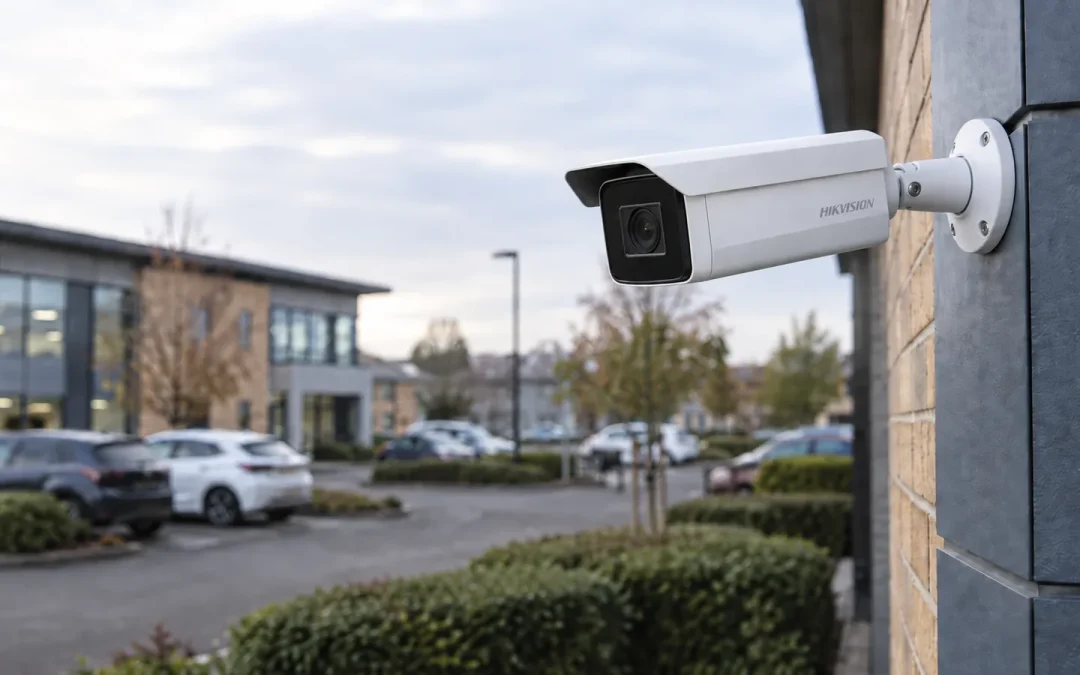
For this site we specified Hikvision 4K IP cameras (internet protocol cameras that send footage digitally over a network, rather than down old-style analogue cable). They give us more to work with – sharper images and built-in functions like line-crossing detection (the camera flags when someone crosses a boundary you’ve drawn on screen). The clarity on a modern 4K camera is hard to believe if the last system you saw was ten years old. When footage actually needs to identify someone, that detail is the difference between useful evidence and a blurry shape.
One cable instead of three
Here’s something most business owners never think about: how the cable gets from the camera back to the recorder. On a big site, it matters more than you’d expect.
Run three cameras the old way and that’s three separate cable runs, each heading all the way back to the recorder – sometimes 100 metres or more. Instead, we can run one cable to a local network switch (a small unit that lets several cameras share a single route back). From there, we pick up all three cameras. A 20-metre run to a switch beats a 100-metre run to the recorder every time.
Why should you care? It saves cable, it saves installation time and it keeps costs sensible. It also makes awkward camera positions viable – if you want a camera somewhere tricky, this is often what makes it affordable to put one there.
The alarm and the cameras, working together
Alongside the cameras we installed a Texecom intruder alarm – the alarm system we use most often for commercial installations.
The two work hand in hand. If the alarm activates, you can open the camera app and see what’s actually happening on the property. No guessing whether it’s a real intruder or a fox crossing the car park.
That combination – an intruder alarm and CCTV system you can check yourself – gives a business proper awareness of its own premises. The car park covered. The front door covered. A view around the whole area, from your phone.
Why we always quote for maintenance
Every quotation we send has a maintenance programme priced alongside the installation. It’s a separate line, and you can take it or leave it. But it’s there from day one, not sprung on you later. A security system you don’t check is a security system you can’t fully trust.
A sensor can develop a hidden fault. A backup battery can quietly age. A recorder can shut down abnormally without anyone noticing, and you only find out footage is missing when you actually need it. None of that announces itself. An annual check catches it before it becomes the reason your system let you down on the one night it mattered.
If your alarm has police response, regular servicing is required to keep the system compliant with the relevant standards and police requirements. These systems are monitored by an approved Alarm Receiving Centre, which can pass a confirmed alarm to the police. A confirmed alarm means two separate triggers have gone off. That’s the level of evidence the police look for.
For other systems, we still recommend a yearly visit to test the equipment, check the backup batteries, clean the cameras and confirm that the recorder is working correctly.
Not everyone takes the maintenance plan. Many do – because regular servicing gives them confidence that the system will be ready when they need it.
Thinking about your own premises?
Whether you run a call centre, an office, a warehouse or a shop in Basildon and need commercial CCTV installation in Basildon, the principle is the same. Cover the points that can be breached, and do it before someone finds them for you.
We’ll walk your site, map the routes a criminal would take and design a system around your actual building – not a price list. We’re SSAIB registered for both intruder alarms and CCTV. That’s the Security Systems and Alarms Inspection Board, the independent body that audits security installers. Our engineers are DBS-checked (background-checked through the government’s Disclosure and Barring Service) and only ever a phone call away.
Book your free site survey today. Call us on 01702 467850 or use the form on this page.